

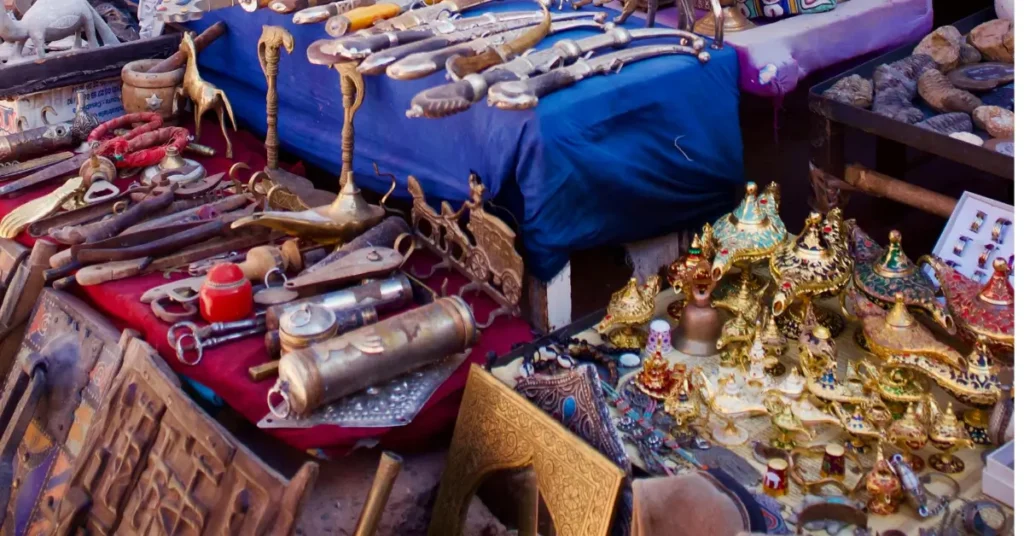
Introduction — The Souk That Shocked Me, Confused Me & Finally Charmed Me
I’ve been to dozens of markets around the world—Bangkok’s Chatuchak, Istanbul’s Grand Bazaar, India’s Sarojini, Dubai’s Dragon Mart—but nothing prepared me for the Marrakech Street Market.
This place is alive in a way that is hard to explain unless you’ve walked through its narrow alleys.
The first time I entered the souk, I felt:
- overstimulated (too many sounds, colors, people)
- lost (lanes look the same)
- targeted (tourist? Yes? Come, my friend!)
- excited (everything is handmade and beautiful)
It’s chaotic, but not in a dangerous way — more like an ancient marketplace where the rules are unwritten and everyone is hustling to survive.
If you’re going in 2025, this guide will give you a massive advantage — both financially and mentally.
Let’s break it down.
⭐ Quick Highlights (2025 Updated)
(Expanded)
- Best time:
→ 10 AM – 1 PM (cool, easy bargaining)
→ 5 PM – 7 PM (golden light, energetic vibe) - Avoid peak heat:
→ 2 PM – 4 PM (shops half-shut, sellers irritated) - Bargaining difficulty:
→ High. They’re trained negotiators. - Cash > Cards:
→ Card payments often include 3–5% hidden fees. - Biggest tourist mistakes:
→ Buying too early
→ Showing too much interest
→ Believing “special price for you, my friend” - Average realistic spending:
→ 300–1500 MAD per visit (depending on what you buy)
Where Exactly is the Souk? (And Why This Matters)
The Marrakech Souk isn’t “one market.”
It’s a labyrinth of 40+ connected mini-markets, each specializing in something different.
This is why most tourists get disoriented.
Google Maps works… until it doesn’t.
Many lanes look identical.
The Souk starts right behind Jamaa el-Fnaa Square
This square is an intense experience:
- drummers
- henna artists
- orange juice vendors
- snake charmers
- monkeys (sadly used for photos)
- street food dealers
- aggressive sales tactics
It’s like a theatrical stage.
Once you cross this square, the souk entrances begin.
Best Entrance for First-Time Visitors
Derb Dabachi
Why?
- Gentle crowd
- Less harassment
- Shops don’t jump on you
Other entrances feel like being swallowed by an ocean of noise.
How to Reach the Souk (Transport Breakdown)
🚕 Taxi
The only rule:
NEGOTIATE BEFORE SITTING INSIDE.
“Métre broken” is the national dialogue.
Typical cost within the city: 20–50 MAD
🚶 On Foot
If your hotel/hostel/riad is near the Medina, walking is the best.
🛵 Scooter
Not recommended unless you’re used to chaotic traffic.
Market Timings in 2025 (Realistic View)
Many travel sites give “official timings.”
The truth?
Each shopkeeper operates on his own schedule.
Summer (Hot season)
9:30 AM – 9:00 PM
Shops stay open late because evenings are lively.
Winter
10:00 AM – 7:30 PM
Gets dark early → souk feels quieter.
Fridays
Slow mornings. Many shops open after prayer.
Ramadan
Everything closes early, especially food-related lanes.
What You’ll Find Inside the Souk (Deep Breakdown & Honest Price Ranges)
The souk is designed like layers—
every 20–30 steps you enter a new micro-world.
Below is what you’ll find, along with realistic prices, quality indicators, and common scams.
🧺 Moroccan Rugs (Berber Rugs)
Price Range (2025):
800–4000 MAD
Tourist asking price often starts at 2000–7000 MAD.
Quality Indicators:
- Handwoven rugs feel heavier
- Patterns are slightly irregular
- Colors are earth-toned (not neon)
Scam Warning
Shops selling “vintage” rugs at insane prices → 90% are recently made.
Personal Note
This is the MOST exhausting bargaining experience.
Rug sellers are expert negotiators.
Drink water before entering a rug shop.
🪔 Brass Lamps (The Marrakech Icon)
Price Range:
150–600 MAD
How to Check Quality
- Edges should be smooth
- Holes perfect (not jagged)
- Handmade lamps are heavier
Buying Tip
Don’t buy the first lamp you fall in love with.
Trust me — you’ll see 100 more.
👝 Leather Bags
Price Range:
200–800 MAD
Real vs Fake Leather
- Real leather smells earthy
- Fake leather smells like chemicals
- Real leather feels grainy, not plastic-smooth
My Experience
Leather shops will try to guilt-trip you:
“You like? You are my first customer today!”
Don’t fall for it.
🍵 Spices (Hidden Danger Zone)
Prices:
- Saffron: 30–70 MAD per gram (real)
- Ras El Hanout: 20–50 MAD per 50g
How to Identify Fake Saffron
- Color too bright red → fake
- Smells like perfume → fake
- Sinks too fast in water → fake
Observation
Half the shops sell mixed saffron.
Buy only from reputable spice sellers.
🍽 Ceramics & Pottery
Beautiful gifts, but fragile.
Prices:
30–120 MAD per piece
Tip
Ask them to wrap items carefully — they usually do it well.
👗 Traditional Clothing
Price:
120–350 MAD
Suggestion
Go for kaftans with hand-stitched details — far better quality.
🪵 Wooden Crafts
Small items that are great to take home.
Price:
40–250 MAD
Warning
Some are machine-made but sold as handmade.
The Art of Bargaining (Real Human Psychology Behind It)
Bargaining here is NOT optional.
It’s cultural.
And honestly, it’s fun once you get the hang of it.
✔ Rule 1 — Start at 30%
If they ask 300 MAD → you say 100 MAD.
✔ Rule 2 — Keep a poker face
Excitement = higher price.
✔ Rule 3 — Walk away
The strongest technique.
Works 8 out of 10 times.
✔ Rule 4 — Shop alone
Group = tourist = money.
✔ Rule 5 — Don’t bargain too much
If something takes 20 minutes… you’re probably getting scammed.
Best Souks Inside the Medina (Lane-by-Lane Map)
Here are the main souk areas, what they sell, and whether they’re worth your time.
1) Souk Semmarine
- Colorful lanes
- Carpets, lamps, pottery
- Highest tourist pricing
- Amazing for photos
2) Souk El Attarine
- Perfumes and spices
- Lots of fraud saffron sellers
3) Carpet Souk
- Rug heaven
- Difficult bargaining
- Salespeople pushy
4) Souk Fekharine
- Pottery-focused
- Less touristy → better prices
5) Souk Cherifia
- Modern boutiques
- Trendy items
- Prices fixed or partially negotiable
Safety Tips (From Someone Who Learned by Mistakes)
❌ Fake Guide Scam
Teenagers will try to “help” you.
They aren’t helping.
They will DEMAND money later.
❌ Pickpockets
Keep your bag in front.
Use a zipper bag.
❌ Photo Charges
Ask before taking photos.
Some will expect payment.
❌ Over-friendly shopkeepers
If someone is too nice — they want your money, not friendship.
What NOT to Buy (Hard Truth)
Not everything is worth buying.
❌ Bright red saffron (fake)
❌ Cheap leather bags (PVC)
❌ Extremely shiny “antiques” (machine-made)
❌ Rugs with chemical smell
❌ “Silver” items that are clearly aluminum
Food You Should Try Near the Souk
After 3–4 hours of walking, you WILL get hungry.
Try these:
- Chicken Tagine
- Moroccan Mint Tea
- Berber Bread
- Fresh Orange Juice (10 MAD)
- Lamb skewers near the square
Food here is affordable and flavorful.
Photography Tips (From Hours of Experimenting)
- Morning light = soft shadows
- Evening = warm golden tones
- Ask permission before photographing people
- Wide-angle lens is perfect for tight alleys
- Avoid blocking shop entrances
My Realistic 1-Day Souk Plan (Works Perfectly)
Morning
Ceramic + spices
(quiet, calm, better negotiation)
Noon
Rugs
(best time to compare without crowds)
Evening
Leather, lamps, accessories
(Golden hour photos)
Night
Jamaa el-Fnaa dinner
(perfect ending)
Conclusion
The Marrakech Street Market is an explosion of culture — noisy, colorful, chaotic, beautiful, frustrating, addictive — all at once.
It’s not a place you simply “shop” in; it’s a place that teaches you how people in this part of the world live, sell, negotiate, and survive.
Go with patience.
Go with curiosity.
Go with the expectation that you’ll get lost, get confused, get overwhelmed…
but also get some of the most unique souvenirs and memories of your life.
And once you understand how this market works, you’ll fall in love with it — just like I did.
Is Marrakech Souk safe?
Safe enough — but crowded. Stay aware.
Are prices fixed?
Almost never. Everything is negotiable.
Should I bring cash?
YES. Cards have hidden fees.
How much time do I need?
At least 3–5 hours for a proper exploration.
